
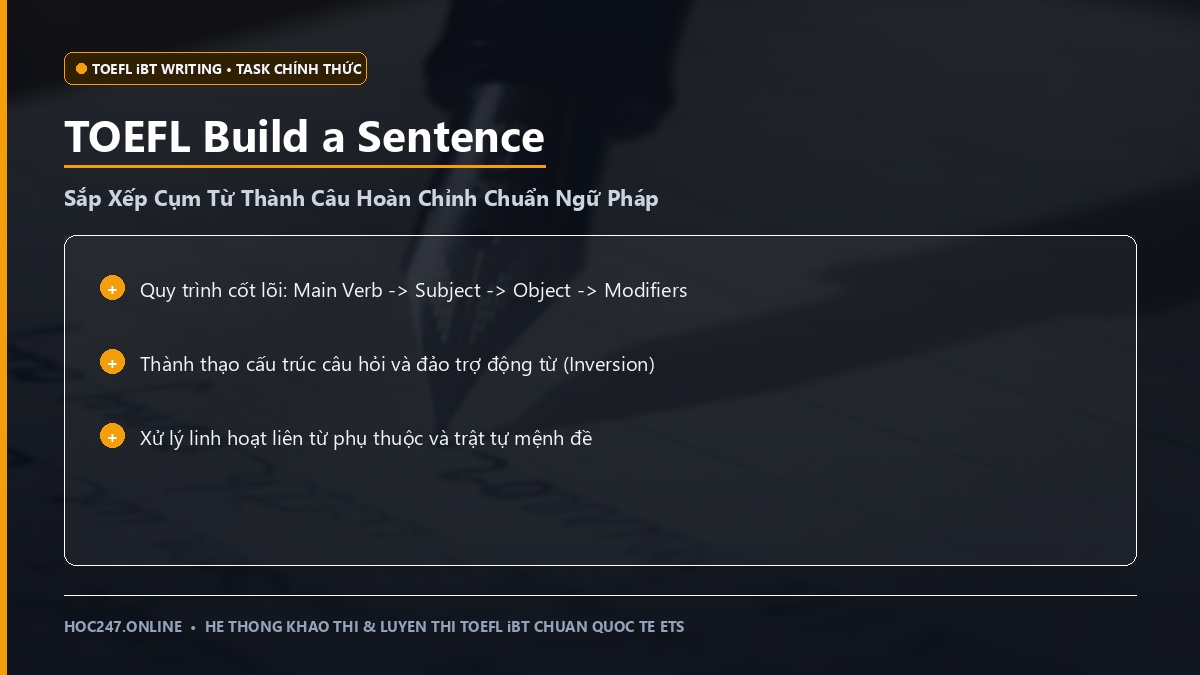
Trong bài thi TOEFL iBT hiện hành, phần thi Viết đã được hiện đại hóa với các dạng bài đo lường năng lực ngữ pháp và tư duy cấu trúc từ nền tảng. Task TOEFL Build a Sentence yêu cầu người học sắp xếp các từ hoặc cụm từ rời rạc thành một câu trần thuật hoặc câu hỏi hoàn chỉnh, chính xác tuyệt đối về mặt ngữ pháp. Việc làm chủ trật tự từ (word order), vị trí bổ ngữ và hiện tượng đảo ngữ trong dạng bài này là bước đệm then chốt để bạn đạt điểm cao ở cả các bài viết email và thảo luận học thuật.
✍️ Chuyên đề TOEFL iBT Writing tại HOC247
Xây dựng nền tảng ngữ pháp và kỹ năng viết học thuật chuẩn ETS theo mô hình Topic Cluster:
- Tổng quan kỹ năng Writing: TOEFL Writing: Cấu trúc bài thi mới & Kỹ thuật đạt 28+ điểm Viết
- Dạng bài sắp xếp câu (Hiện tại): TOEFL Build a Sentence: Cách sắp xếp từ và cụm từ thành câu hoàn chỉnh
- Lỗi ngữ pháp thường gặp: TOEFL Build a Sentence Grammar: 10 lỗi sắp xếp câu dễ mất điểm
- Kỹ năng viết Email: TOEFL Write an Email: Cách viết đúng tình huống và mục đích
- Phòng thi máy tính: Làm bài thi thử TOEFL Practice Test mô phỏng chuẩn ETS trên HOC247
1. Bản chất chính thức của task TOEFL Build a Sentence từ ETS
Theo tài liệu khảo thí chính thức từ Viện Khảo thí Giáo dục Hoa Kỳ (ETS TOEFL iBT Test Content Specifications), Build a Sentence là một nhiệm vụ chính thức (official task type) trong phần thi Writing thế hệ mới.
Đặc trưng khảo thí của task này:
- Thí sinh được cung cấp một tập hợp các từ hoặc cụm từ bị xáo trộn vị trí (scrambled words or phrases).
- Nhiệm vụ là kéo thả hoặc sắp xếp các khối từ (chunks) này thành một câu trần thuật hoàn chỉnh (complete sentence) hoặc một câu hỏi (question) đúng ngữ pháp tiếng Anh tiêu chuẩn.
- Mục tiêu đo lường: Đánh giá sự hiểu biết vững chắc của thí sinh về English sentence structure (cấu trúc câu, trật tự từ, trật tự bổ ngữ và mối quan hệ giữa các mệnh đề).
⚠️ Phân biệt định dạng: Đây KHÔNG PHẢI là Essay hay Fill-in-the-blank
Build a Sentence không phải là bài viết luận (Essay), không phải là bài tìm lỗi sai (Sentence correction), cũng không phải là bài điền từ vào chỗ trống (Fill-in-the-blank). Thí sinh không được tự tiện thêm bớt từ vựng bên ngoài mà phải sử dụng chính xác toàn bộ các mảnh ghép được cung cấp để tạo thành câu hoàn chỉnh duy nhất đúng.
2. Chiến lược 4 bước giải quyết: Từ Động từ cốt lõi đến Bổ ngữ
Nhiều người học theo phản xạ tự nhiên thường đi tìm Chủ ngữ đầu tiên. Tuy nhiên, trong tiếng Anh, Động từ (Verb) mới là trái tim chi phối toàn bộ cấu trúc của câu. Quy trình 4 bước chuẩn mực dưới đây giúp bạn giải quyết mọi câu phức tạp trong vòng dưới 30 giây:
Bước 1: Tìm Động từ chính (Main Verb) hoặc Cụm động từ
Hãy quét nhanh các khối từ để xác định động từ chia thì (finite verb). Động từ đó là nội động từ (intransitive), ngoại động từ (transitive), hay động từ liên kết (linking verb)?
Các khối từ: [the professor] / [explained] / [the new policy] / [to the students]
→ Động từ chính: explained (ngoại động từ yêu cầu tân ngữ sự vật + giới từ ‘to’ chỉ đối tượng).
Bước 2: Tìm Chủ ngữ logic (Subject)
Đặt câu hỏi: Ai hoặc cái gì là chủ thể thực hiện hành động của động từ chính? Tránh chọn danh từ đứng gần động từ một cách máy móc mà phải xét ý nghĩa ngữ nghĩa (semantic role). Trong ví dụ trên, chủ thể hành động là the professor.
Bước 3: Nhận diện cấu trúc động từ (Verb Patterns)
Mỗi động từ tiếng Anh đi kèm với cấu trúc tân ngữ cố định. Nắm chắc các pattern phổ biến:
ask / tell / allow / require + someone + to do somethingsuggest / recommend + that + S + (should) do somethingprovide + someone + with + something(hoặcprovide something for someone)be interested in / capable of + V-ing / noun
Bước 4: Sắp xếp các thành phần bổ ngữ (Modifiers & Adverbials)
Đặt các bổ ngữ vào đúng vị trí theo quy tắc cú pháp:
- Tính từ (Adjective): Đứng trước danh từ mà nó bổ nghĩa (a comprehensive survey).
- Trạng từ chỉ tần suất / cách thức (Adverb): Đứng trước động từ thường, sau trợ động từ hoặc động từ to be (students can easily access).
- Cụm giới từ (Prepositional Phrase): Đứng sau tân ngữ hoặc ở cuối câu để chỉ thời gian, nơi chốn, phương thức (in the multimedia auditorium).
- Mệnh đề quan hệ (Relative Clause): Đặt ngay sau danh từ tiền từ mà nó bổ nghĩa (the article that the advisor recommended).
3. Cấu trúc câu trần thuật (Statements) vs. Cấu trúc câu hỏi (Questions)
Trật tự câu trần thuật
Mô hình chuẩn: Subject + Auxiliary + Main Verb + Object / Complement + Modifier. Tuy nhiên, khi có trạng từ hoặc cụm giới từ chỉ thời gian đứng đầu câu, cần chú ý dấu phẩy và vị trí chủ ngữ.
Trật tự câu hỏi và Đảo trợ động từ (Inversion)
Dạng câu hỏi trong TOEFL Build a Sentence là cái bẫy lớn nhất khiến học viên mất điểm do quên đảo trợ động từ lên trước chủ ngữ:
1. Wh-Questions (Câu hỏi có từ để hỏi):
Wh-word + Auxiliary (do/does/did/is/are/can/will) + Subject + Main Verb + Complement?
Khối từ: [When] / [does] / [the main library] / [close] / [on weekends]
→ When does the main library close on weekends?
2. Yes/No Questions (Câu hỏi đảo):
Auxiliary + Subject + Main Verb + Object?
Khối từ: [Have] / [you] / [submitted] / [your lab report] / [to the assistant]
→ Have you submitted your lab report to the assistant?
4. Xử lý câu phức và mệnh đề liên kết (Clauses & Connectors)
Khi câu xuất hiện các liên từ phụ thuộc như because, although, if, when, while, since hoặc đại từ quan hệ that, which, who, bạn phải phân định rõ đâu là mệnh đề chính (main clause) và đâu là mệnh đề phụ (subordinate clause).
Ví dụ: [Although the weather was harsh] / [the geological team] / [completed] / [their field expedition]
→ Mệnh đề phụ thuộc đứng đầu: Although the weather was harsh, theo sau là mệnh đề chính hoàn chỉnh: the geological team completed their field expedition.
5. 12 Ví dụ minh họa từ Dễ đến Nâng cao (Kèm Phân tích Cấu trúc)
Ví dụ 1 (Đơn giản – Câu khẳng định):
[the registrar’s office] / [issues] / [student ID cards] / [every morning]
→ Câu đúng: The registrar’s office issues student ID cards every morning.
Cấu trúc: Subject (The registrar’s office) + Verb (issues) + Object (student ID cards) + Time adverbial (every morning).
Ví dụ 2 (Đơn giản – Câu bị động):
[all library computers] / [are upgraded] / [during the summer break]
→ Câu đúng: All library computers are upgraded during the summer break.
Cấu trúc: Passive Subject (All library computers) + Passive Verb (are upgraded) + Prepositional modifier (during the summer break).
Ví dụ 3 (Đơn giản – Câu hỏi Yes/No):
[Can] / [freshmen] / [reserve] / [private study carrels] / [in advance]
→ Câu đúng: Can freshmen reserve private study carrels in advance?
Cấu trúc: Modal auxiliary (Can) + Subject (freshmen) + Verb (reserve) + Object (private study carrels) + Prepositional phrase (in advance)?
Ví dụ 4 (Trung bình – Wh-question với trợ động từ):
[Where] / [did] / [the professor] / [publish] / [her latest research findings]
→ Câu đúng: Where did the professor publish her latest research findings?
Cấu trúc: Wh-word (Where) + Auxiliary (did) + Subject (the professor) + Base verb (publish) + Object (her latest research findings)?
Ví dụ 5 (Trung bình – Cấu trúc động từ nguyên mẫu có ‘to’):
[The department head] / [encouraged] / [graduate students] / [to submit] / [conference papers]
→ Câu đúng: The department head encouraged graduate students to submit conference papers.
Cấu trúc: Subject + Verb (encouraged) + Object (graduate students) + to-infinitive complement (to submit conference papers).
Ví dụ 6 (Trung bình – Vị trí trạng từ chỉ cách thức):
[Students] / [can] / [easily download] / [the lecture slides] / [from the university portal]
→ Câu đúng: Students can easily download the lecture slides from the university portal.
Cấu trúc: Trạng từ easily đứng giữa trợ động từ khiếm khuyết can và động từ nguyên thể download.
Ví dụ 7 (Trung bình – Mệnh đề trạng ngữ chỉ điều kiện):
[If you submit the waiver form] / [the administrative office] / [will cancel] / [the late fee]
→ Câu đúng: If you submit the waiver form, the administrative office will cancel the late fee.
Cấu trúc: Conditional subordinate clause (If + S + V) + Main clause (S + will + V + O).
Ví dụ 8 (Nâng cao – Mệnh đề quan hệ xác định):
[The textbook] / [that the professor assigned] / [is available] / [in electronic format]
→ Câu đúng: The textbook that the professor assigned is available in electronic format.
Cấu trúc: Subject (The textbook) được bổ nghĩa ngay bởi relative clause (that the professor assigned) + Linking verb (is) + Adjective complement (available) + Prepositional phrase.
Ví dụ 9 (Nâng cao – Mệnh đề danh ngữ làm tân ngữ):
[The teaching assistant] / [clarified] / [why the laboratory protocol] / [had been modified]
→ Câu đúng: The teaching assistant clarified why the laboratory protocol had been modified.
Cấu trúc: Subject + Main Verb (clarified) + Noun clause làm tân ngữ (why + S + had been modified – giữ nguyên trật tự câu trần thuật).
Ví dụ 10 (Nâng cao – Câu hỏi gián tiếp):
[Do you know] / [which academic advisor] / [handles] / [international student visas]
→ Câu đúng: Do you know which academic advisor handles international student visas?
Cấu trúc: Main question (Do you know) + Embedded question làm tân ngữ (which academic advisor handles international student visas – không đảo trợ động từ).
Ví dụ 11 (Nâng cao – Cụm phân từ rút gọn):
[Having reviewed the survey data] / [the committee] / [recommended] / [revising the campus transit schedule]
→ Câu đúng: Having reviewed the survey data, the committee recommended revising the campus transit schedule.
Cấu trúc: Participle phrase chỉ thời gian/hoàn thành + Main clause (Subject + Verb + Gerund object).
Ví dụ 12 (Nâng cao – Đảo ngữ với trạng từ phủ định):
[Seldom] / [have] / [astronomers] / [observed] / [such an intense gamma-ray burst]
→ Câu đúng: Seldom have astronomers observed such an intense gamma-ray burst.
Cấu trúc: Negative adverbial (Seldom) đứng đầu câu → Đảo trợ động từ have lên trước chủ ngữ astronomers.
6. Mini Practice: 20 câu bài tập sắp xếp câu toàn diện (Kèm đáp án)
Hãy tự sắp xếp các khối từ dưới đây thành câu hoàn chỉnh và đối chiếu đáp án cùng phân tích chi tiết:
Câu 1 (Simple Statement):
[requires] / [a valid student card] / [the computer laboratory] / [for after-hours access]
👉 Xem đáp án & giải thích
Subject: The computer laboratory | Verb: requires | Object: a valid student card | Modifier: for after-hours access.
Câu 2 (Simple Statement):
[must complete] / [their safety orientation] / [all chemistry students] / [before Friday]
👉 Xem đáp án & giải thích
Subject: All chemistry students | Modal verb: must complete | Object: their safety orientation | Modifier: before Friday.
Câu 3 (Simple Statement):
[provides] / [the career guidance center] / [free resume critiques] / [to graduating seniors]
👉 Xem đáp án & giải thích
Cấu trúc provide something to/for someone.
Câu 4 (Simple Statement):
[will conduct] / [field measurements] / [the environmental biology class] / [along the riverbank]
👉 Xem đáp án & giải thích
Subject: The environmental biology class | Verb: will conduct | Object: field measurements | Place modifier: along the riverbank.
Câu 5 (Simple Statement):
[in the west parking garage] / [is prohibited] / [overnight parking] / [without an official decal]
👉 Xem đáp án & giải thích
Subject: Overnight parking in the west parking garage | Passive verb: is prohibited | Condition modifier: without an official decal.
Câu 6 (Question):
[When] / [does] / [the registration deadline] / [expire] / [for the winter term]
👉 Xem đáp án & giải thích
Wh-word (When) + Auxiliary (does) + Subject (the registration deadline for the winter term) + Verb (expire)?
Câu 7 (Question):
[Has] / [the department chair] / [approved] / [your independent study syllabus]
👉 Xem đáp án & giải thích
Auxiliary (Has) + Subject (the department chair) + Past participle (approved) + Object (your independent study syllabus)?
Câu 8 (Question):
[Why] / [did] / [the professor] / [cancel] / [the review session] / [yesterday afternoon]
👉 Xem đáp án & giải thích
Wh-word (Why) + Auxiliary (did) + Subject (the professor) + Verb (cancel) + Object + Time modifier.
Câu 9 (Question):
[How many references] / [must] / [students] / [include] / [in the final literature review]
👉 Xem đáp án & giải thích
Question phrase (How many references) + Modal (must) + Subject (students) + Verb (include) + Prepositional phrase.
Câu 10 (Question):
[Where] / [can] / [undergraduates] / [find] / [the academic tutoring schedule]
👉 Xem đáp án & giải thích
Wh-word (Where) + Modal (can) + Subject (undergraduates) + Verb (find) + Object.
Câu 11 (Complex Sentence):
[Although the experiment was delayed] / [the research team] / [obtained] / [accurate spectrometer readings]
👉 Xem đáp án & giải thích
Mệnh đề nhượng bộ đứng trước, theo sau là mệnh đề chính.
Câu 12 (Complex Sentence):
[Because the server was undergoing maintenance] / [students] / [could not submit] / [their online quizzes]
👉 Xem đáp án & giải thích
Mệnh đề nguyên nhân (Because…) bổ nghĩa cho mệnh đề chính kết quả.
Câu 13 (Complex Sentence):
[The article] / [that was published in Nature] / [challenged] / [conventional archaeological theories]
👉 Xem đáp án & giải thích
Mệnh đề quan hệ (that was published in Nature) bổ nghĩa cho chủ ngữ The article.
Câu 14 (Complex Sentence):
[unless they maintain] / [a cumulative GPA of 3.5] / [students] / [cannot qualify for the honors seminar]
👉 Xem đáp án & giải thích
Mệnh đề chính đứng trước + Mệnh đề điều kiện phủ định (unless…).
Câu 15 (Complex Sentence):
[The geologist explained] / [that seismic activity along the fault] / [had increased dramatically] / [over the past decade]
👉 Xem đáp án & giải thích
Subject + Verb + that-noun clause làm tân ngữ.
Câu 16 (Mixed / Advanced):
[Only after submitting the ethics approval] / [can] / [researchers] / [begin] / [human participant interviews]
👉 Xem đáp án & giải thích
Cấu trúc đảo ngữ: Only after + V-ing + Modal auxiliary (can) + Subject (researchers) + Verb (begin).
Câu 17 (Mixed / Advanced):
[The committee] / [agreed on] / [neither the proposed budget increase] / [nor the revised timeline]
👉 Xem đáp án & giải thích
Cấu trúc tương quan: agreed on neither A nor B.
Câu 18 (Mixed / Advanced):
[Not only did the student pass the comprehensive examination] / [but she also] / [received] / [a distinguished scholarship]
👉 Xem đáp án & giải thích
Cấu trúc đảo ngữ: Not only did + S + V, but S also + V.
Câu 19 (Mixed / Advanced):
[The professor insisted that] / [every laboratory report] / [be submitted] / [in standard PDF format]
👉 Xem đáp án & giải thích
Cấu trúc giả định thức (Subjunctive mood): insist that + S + (should) be + V3/ed.
Câu 20 (Mixed / Advanced):
[Were the university to expand the science complex] / [additional laboratory equipment] / [would be required] / [immediately]
👉 Xem đáp án & giải thích
Đảo ngữ câu điều kiện loại 2: Were + S + to-V, S + would + be + V3/ed.
7. Câu hỏi thường gặp (FAQ) về TOEFL Build a Sentence
1. TOEFL Build a Sentence là gì?
Là dạng bài thi chính thức trong TOEFL Writing hiện hành, yêu cầu thí sinh sắp xếp các từ hoặc cụm từ bị xáo trộn thành một câu trần thuật hoặc câu hỏi chuẩn xác về ngữ pháp.
2. Thí sinh có cần tự gõ thêm từ ngữ vào bài không?
Không. Bạn chỉ sắp xếp các từ/cụm từ có sẵn bằng thao tác kéo thả hoặc lựa chọn thứ tự được cung cấp trên giao diện phần mềm thi.
3. Nên tìm chủ ngữ hay động từ trước khi làm bài?
Nên tìm động từ chính trước. Động từ sẽ quyết định số lượng tân ngữ, giới từ đi kèm và giúp bạn nhận diện chủ thể hành động chính xác hơn.
4. Dạng bài này kiểm tra những chủ điểm ngữ pháp nào?
Kiểm tra trật tự từ cơ bản (S-V-O), cấu trúc câu hỏi đảo trợ từ, vị trí tính từ/trạng từ/cụm giới từ, mệnh đề quan hệ và các liên từ ghép nối.
5. Làm sao nhận diện và xử lý dạng câu hỏi?
Để ý dấu chấm hỏi ở khối từ cuối cùng hoặc sự xuất hiện của các từ để hỏi (Wh-words) và trợ động từ (Do/Does/Did/Can/Will). Luôn nhớ đảo trợ từ lên trước chủ ngữ.
6. Có cần đọc lại toàn câu sau khi sắp xếp không?
Rất cần thiết. Bước đọc lại giúp bạn kiểm tra tính mạch lạc về mặt ngữ nghĩa (meaning check) và phát hiện các vị trí bổ ngữ bị đặt sai gây hiểu nhầm.
7. Luyện tập Build a Sentence có giúp ích cho phần viết luận không?
Có, cực kỳ hiệu quả. Phản xạ sắp xếp câu giúp bạn chấm dứt các lỗi ngữ pháp cơ bản (run-on sentence, fragment, misplaced modifier) khi viết bài luận học thuật dài.
Rèn luyện phản xạ ngữ pháp TOEFL Build a Sentence trên HOC247
Sau khi nắm Subject → Verb → Complement và vị trí modifier, hãy luyện thêm các câu Build a Sentence để hình thành phản xạ nhận biết cấu trúc trong bộ đề thi thử TOEFL Practice Test.