
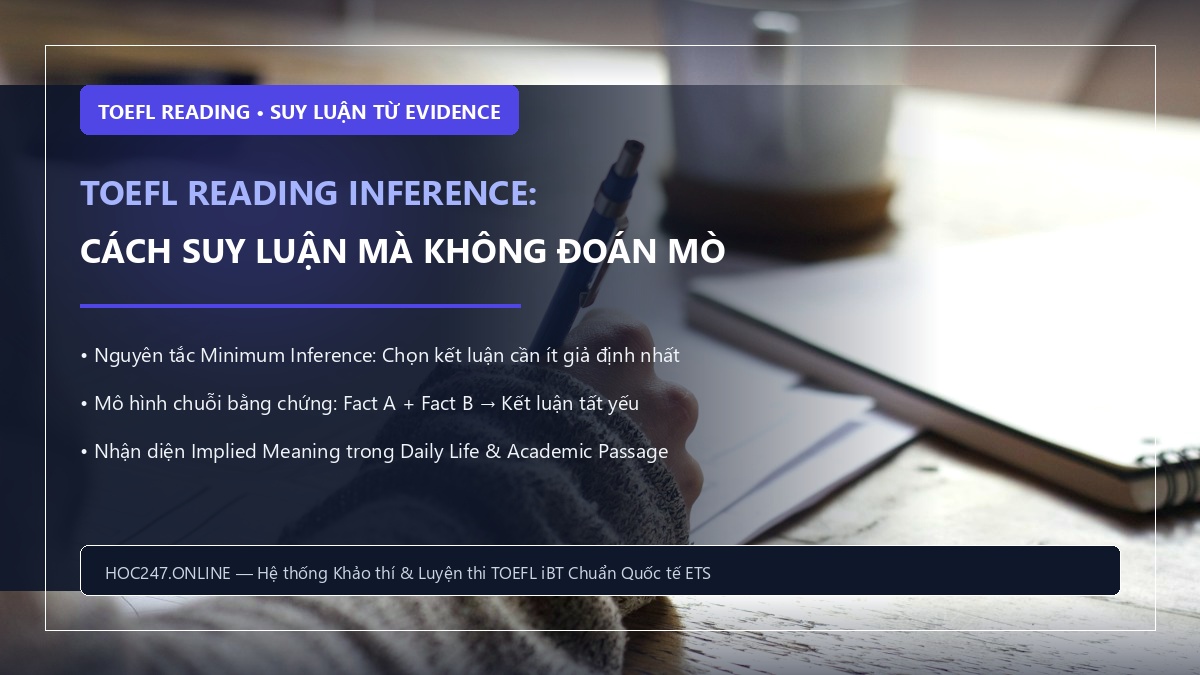
Trong bài thi TOEFL iBT hiện hành, các câu hỏi suy luận (Inference questions) luôn được xem là thử thách phân hóa điểm số giữa nhóm điểm khá và nhóm điểm xuất sắc. Thách thức lớn nhất khi xử lý TOEFL Reading Inference là người học thường nhầm lẫn giữa “suy luận logic có căn cứ” (evidence-based deduction) với “phỏng đoán theo thường thức” (common-sense speculation). Nhiều thí sinh chọn một đáp án nghe rất hợp lý trong thực tế đời sống nhưng lại hoàn toàn không được dữ kiện trong bài đọc hỗ trợ.
Bài viết này phân tích tiêu chuẩn khảo thí chính thức của ETS đối với kỹ năng suy luận, thiết lập bảng đối chiếu Fact vs. Inference vs. Assumption, làm sáng tỏ nguyên tắc tối thiểu giả định (Minimum Inference Principle), mô hình chuỗi bằng chứng (Evidence Chain) cùng quy trình 6 bước giải quyết câu hỏi suy luận. Bài viết cũng cung cấp 6 bài mẫu phân tích chuyên sâu và bộ 10 câu mini practice (4 Daily Life + 6 Academic) có giải thích chi tiết từng bẫy nhiễu.
Hệ thống Topic Cluster TOEFL iBT tại HOC247
Làm chủ toàn bộ kỹ năng Đọc hiểu học thuật theo chuẩn quốc tế:
- Trang kỹ năng trụ cột: TOEFL Reading: Cấu trúc bài thi & Kỹ thuật làm bài đạt điểm cao
- Kỹ năng xác định ý chính: TOEFL Reading Main Idea: Cách xác định ý chính của bài đọc
- Kỹ năng nhận diện diễn đạt tương đương: TOEFL Reading Paraphrase: Cách nhận biết cùng ý khác cách viết
- Luyện thi trực tuyến chuẩn ETS: Làm TOEFL Practice Test trên máy tính tại HOC247
1. Bản chất của Inference trong quy chuẩn TOEFL Reading hiện hành
Theo tài liệu khảo thí chính thức từ ETS TOEFL iBT Reading Specification, phần thi Reading hiện hành không có một “Inference Task” độc lập. Thay vào đó, bài thi gồm 3 task types:
- Complete the Words: Điền các chữ cái còn thiếu vào từ vựng theo văn cảnh.
- Read in Daily Life: Đọc các văn bản đời sống học đường ngắn, trong đó câu hỏi trực tiếp đánh giá implied meaning (ngụ ý ẩn sau thông báo).
- Read an Academic Passage: Đọc văn bản học thuật chuyên sâu, đánh giá khả năng hiểu các inferred meanings từ các bằng chứng phức tạp.
Do đó, TOEFL Reading Inference là kỹ năng nhận diện thông tin ngụ ý (implied meaning) và rút ra kết luận hợp lý mà tác giả cố ý không nêu ra bằng câu chữ hiển ngôn, nhưng đã cung cấp đầy đủ tiền đề logic để người đọc tự suy ra.
2. Bảng phân biệt: Fact vs. Inference vs. Assumption
Để không bao giờ chọn nhầm đáp án, thí sinh cần phân biệt rõ ba ranh giới tư duy sau:
| Khái niệm | Bản chất logic | Ví dụ kiểm chứng |
|---|---|---|
| Fact (Sự thật trực tiếp) | Thông tin được tác giả phát biểu trực tiếp, nguyên văn hoặc được diễn đạt lại bằng từ đồng nghĩa trong bài đọc. | “After the university extended library hours during examinations, evening attendance increased substantially.” |
| Inference (Suy luận hợp lý) | Kết luận logic không được phát biểu nguyên văn, nhưng được bảo đảm tính đúng đắn 100% nhờ các dữ kiện trong bài đọc hỗ trợ. | Students utilized the newly available evening hours to study during exam periods. (Suy luận chuẩn xác vì số lượng người tham dự tăng đáng kể). |
| Assumption (Giả định chủ quan) | Ý kiến người đọc tự gán ghép thêm dựa vào kinh nghiệm cá nhân, vượt quá phạm vi bằng chứng tác giả cung cấp. | Every university student prefers studying late at night rather than in the morning. (Sai vì bài chỉ nói lượt đến tăng, không nói mọi sinh viên đều thích học đêm). |
3. Nguyên tắc Minimum Inference: Chọn kết luận cần ít giả định nhất
Nguyên tắc sống còn trong câu hỏi suy luận TOEFL là Minimum Inference Principle (Nguyên tắc suy luận tối thiểu). Trong 4 phương án trắc nghiệm, đáp án đúng luôn là bước logic ngắn nhất và an toàn nhất bắt nguồn từ bài đọc.
Nếu để một phương án trở thành đúng, bạn phải tự đặt ra thêm 2-3 giả định phụ (“nếu họ làm thế này thì chắc là họ cũng nghĩ thế kia…”), phương án đó chắc chắn sai. Ngược lại, phương án chỉ cần 1 bước suy luận trực diện từ dữ kiện đã cho là đáp án chính xác của ETS.
4. Mô hình chuỗi bằng chứng (Evidence Chain)
Một câu suy luận học thuật đúng đắn luôn tuân theo công thức chuỗi bằng chứng toán học:
Bằng chứng A (Fact A) + Bằng chứng B (Fact B) ➔ Kết luận logic tất yếu (Inference)
Tuyệt đối không áp dụng: Chủ đề (Topic) + Định kiến cá nhân (Personal belief) ➔ Đáp án suy diễn
Ví dụ minh họa:
- Fact A: Loài chim X chỉ xây tổ ở những khu vực rừng nguyên sinh có độ phủ bóng cây trên 80%.
- Fact B: Hoạt động khai thác gỗ đang làm giảm độ che phủ của khu rừng Y xuống dưới 50%.
- ➔ Reasonable Inference: Khu rừng Y sẽ trở nên kém thuận lợi cho tập tính sinh sản của loài chim X.
- Phương án suy diễn sai: Loài chim X sẽ ngay lập tức tuyệt chủng hoàn toàn trong năm tới (quá cực đoan, không đủ căn cứ).
5. Đặc thù suy luận: Implied Meaning trong Daily Life vs. Academic Context
5.1. Implied Meaning trong văn bản nhật dụng (Daily Life)
Trong các thông báo ngắn của nhà trường, tác giả không viết dài dòng mà hàm ý hành động tiếp theo của sinh viên. Ví dụ:
“The elevator in the central library is undergoing mechanical maintenance today. Visitors needing wheelchair assistance or moving heavy book carts should use the ground-level ramp at the Oak Street entrance.”
- Implied Meaning hợp lý: Lối vào chính thông thường có thể tạm thời không cung cấp lối đi thuận tiện cho xe lăn trong thời gian bảo trì thang máy.
- Suy diễn quá xa (Sai): Toàn bộ thư viện đóng cửa, hoặc thang máy đã bị hỏng hoàn toàn không thể sửa được.
5.2. Inferred Meaning trong văn bản học thuật (Academic Context)
Trong văn bản học thuật, tác giả thường đưa ra các mối tương quan khoa học hoặc lịch sử. Nếu bài viết nêu:
“Species X thrives exclusively in high-altitude environments where temperatures remain below freezing for most of the year. Over the past three decades, average winter temperatures in this mountain range have risen steadily.”
Suy luận hợp lý bắt buộc phải xoay quanh phạm vi sinh tồn của Species X có thể bị thu hẹp lên các độ cao lớn hơn. Thí sinh tuyệt đối không bổ sung các kiến thức sinh học ngoài bài (ví dụ tự suy diễn rằng loài này sẽ tự tiến hóa để chịu nóng).
6. Xử lý các phương án chứa từ ngữ cực đoan (Extreme Options)
Các phương án chứa các từ chỉ mức độ tuyệt đối như all, always, never, only, completely, exclusively, impossible thường có xác suất sai rất cao vì văn bản học thuật luôn dùng ngôn ngữ dè dặt (hedging language: likely, tend to, suggest, often).
Tuy nhiên, lưu ý quan trọng: Từ cực đoan không tự động sai 100%. Nếu văn bản gốc của tác giả thực sự khẳng định mức độ tuyệt đối (ví dụ bài dùng “without exception” hoặc “entirely dependent on”), phương án chứa từ cực đoan đó mới là đáp án đúng. Hãy luôn đối chiếu kỹ lưỡng với bằng chứng gốc.
7. Quy trình 6 bước làm câu hỏi TOEFL Reading Inference
- Bước 1: Nhận diện câu hỏi suy luận: Tìm các tín hiệu nhận diện đặc trưng trong câu hỏi:
- Which of the following can be inferred from paragraph X about…?
- The author implies that…
- It can be reasonably concluded that…
- What does the notice suggest about…?
- Bước 2: Định vị vùng thông tin liên quan (Locate relevant text): Dùng từ khóa chỉ đối tượng trong câu hỏi để tìm đúng câu hoặc đoạn văn chứa tiền đề.
- Bước 3: Xác định và gạch chân bằng chứng (Underline specific evidence): Trích xuất các sự thật khách quan (facts/premises) liên quan trực tiếp đến đối tượng.
- Bước 4: Diễn giải lại bằng chứng (Paraphrase evidence): Hiểu rõ mối liên hệ giữa các sự thật bằng ngôn ngữ đơn giản của chính bạn.
- Bước 5: Loại bỏ các phương án đòi hỏi giả định ngoại lai: Loại ngay các đáp án đúng với đời sống thực nhưng bài đọc không nói đến, hoặc các đáp án đảo ngược quan hệ nhân quả.
- Bước 6: Chọn kết luận gần bằng chứng nhất: Chọn phương án là bước logic tự nhiên, liền kề nhất với dữ kiện bài đọc (Minimum Inference).
8. 7 Bẫy đáp án suy luận kinh điển cần tránh
- Bẫy 1: Common Sense Trap (Bẫy thường thức đời sống): Thấy đáp án đúng với lẽ thường ngoài đời nên chọn ngay, dù bài đọc hoàn toàn không có bằng chứng.
- Bẫy 2: Extreme Claim (Tuyên bố cực đoan): Dùng từ all, never, completely khi bài đọc chỉ nói some, occasionally, partially.
- Bẫy 3: True in Reality but Unsupported: Một sự thật khoa học hiển nhiên ngoài đời thực nhưng bài viết không hề thảo luận.
- Bẫy 4: Keyword Overlap (Trùng từ khóa nhưng bóp méo logic): Sử dụng lại các danh từ đao to búa lớn trong bài nhưng ghép nối sai mối quan hệ nhân quả.
- Bẫy 5: Emotional Interpretation (Suy diễn theo cảm tính): Đoán mò tâm lý tác giả yêu, ghét, lo lắng hay tức giận khi văn phong bài đọc hoàn toàn trung lập.
- Bẫy 6: Leap of Logic (Bước nhảy logic quá xa): Suy luận qua 3-4 tầng phỏng đoán thay vì 1 bước trực tiếp từ văn bản.
- Bẫy 7: Fact Instead of Inference (Nhầm lẫn Fact với Inference): Đề bài hỏi “can be inferred” nhưng đáp án chỉ chép lại y nguyên một câu chữ hiển ngôn trong bài mà không đưa ra kết luận ẩn nào.
9. Phân tích 6 văn bản thực hành chuyên sâu kèm đáp án và bẫy nhiễu
Văn bản 1: Daily Life (Dormitory Notice)
“Starting next month, the resident hall laundry rooms will no longer accept cash or physical laundry tokens. All washing machines and tumble dryers will operate exclusively via the campus digital payment card. Students whose cards have expired or have lost RFID functionality should visit the Student Housing Office before the end of this week to receive a replacement without charge.”
Question: What can be inferred about the resident hall laundry system?
A. Laundry prices will increase significantly starting next month.
B. Students without a functional digital payment card will be unable to use laundry machines next month.
C. Physical tokens were previously issued to students entirely free of charge.
D. The Student Housing Office will be closed permanently at the end of this week.
Đáp án đúng: B
Bằng chứng (Evidence): Bài nêu máy giặt sẽ “operate exclusively via the campus digital payment card” và không nhận tiền mặt hay token nữa. Do đó, nếu không có thẻ hoạt động được, sinh viên không thể dùng máy.
Phân tích bẫy: A không có dữ kiện về giá; C suy diễn ngoài bài; D nói sai sự thật (chỉ là hạn đổi thẻ miễn phí).
Văn bản 2: Daily Life (Internship Advisory)
“Applications for the summer research fellowship at the Marine Institute are highly competitive, typically receiving over four hundred submissions for twenty positions. In past review cycles, candidates who completed advanced coursework in statistical modeling and submitted two faculty recommendations were three times more likely to advance to the interview stage than applicants with general coursework alone.”
Question: What does the advisory imply about the application process?
A. Every applicant with two faculty recommendations is guaranteed an interview.
B. Practical research experience is explicitly prohibited for first-year undergraduates.
C. Candidates with quantitative modeling skills possess a distinct competitive advantage in initial screening.
D. The Marine Institute will increase the number of fellowship positions to four hundred next year.
Đáp án đúng: C
Bằng chứng (Evidence): Ứng viên học advanced coursework in statistical modeling có khả năng vào vòng phỏng vấn cao gấp 3 lần.
Phân tích bẫy: A dùng từ cực đoan guaranteed (bài chỉ nói 3 lần khả năng, không bảo đảm 100%); B bịa đặt; D bóp méo số liệu.
Văn bản 3: Academic Passage (Paleontology)
“Fossilized teeth of early hominins recovered from cave deposits in East Africa reveal microscopic wear patterns characterized by deep striations rather than shallow pits. In modern primates, such linear striations correlate almost exclusively with a diet composed of fibrous vegetation, tubers, and tough roots, whereas pit-heavy wear patterns reflect the consumption of hard-shelled nuts and seeds. Furthermore, isotope ratios of carbon-13 extracted from the enamel closely mirror the signatures found in savannah grasses.”
Question: What can be inferred about the diet of the early hominins described in the passage?
A. They consumed hard-shelled nuts as their primary source of daily caloric intake.
B. Their nutritional sustenance relied heavily on tough, fibrous savannah plants rather than hard seeds.
C. They were incapable of chewing any solid food items without stone grinding tools.
D. Modern primates have completely lost the ability to process fibrous roots.
Đáp án đúng: B
Bằng chứng (Evidence): Răng có vết xước sâu (striations) giống linh trưởng ăn cỏ rễ xơ dai, và tỉ lệ đồng vị carbon-13 khớp với cỏ xavan.
Phân tích bẫy: A trái ngược hoàn toàn (vết pit mới là ăn hạt cứng); C tự suy diễn công cụ đá; D suy diễn sai về linh trưởng hiện đại.
Văn bản 4: Academic Passage (Atmospheric Science)
“During the mid-twentieth century, atmospheric chlorofluorocarbons (CFCs) were hailed as inert, non-toxic miracle compounds ideal for refrigeration. However, upon drifting into the stratosphere, ultraviolet radiation cleaves chlorine atoms from CFC molecules. A single liberated chlorine radical can catalyze the breakdown of up to one hundred thousand ozone molecules through a regenerative catalytic cycle before being removed by natural deposition.”
Question: The author implies that CFCs:
A. Are completely harmless to the atmosphere regardless of altitude.
B. Pose a severe threat to ozone concentration disproportionate to their molecular volume.
C. Cannot be broken down by any natural phenomenon in the upper atmosphere.
D. Were intentionally designed by chemists to accelerate stratospheric degradation.
Đáp án đúng: B
Bằng chứng (Evidence): Một nguyên tử Clo đơn lẻ có thể phá hủy tới 100.000 phân tử ozone thông qua chu trình xúc tác tái sinh, cho thấy tác hại khổng lồ vượt xa số lượng phân tử của chúng.
Phân tích bẫy: A mâu thuẫn bài đọc; C sai vì tia UV chính là hiện tượng tự nhiên bẻ gãy phân tử; D suy diễn ác ý về ý đồ của nhà hóa học.
Văn bản 5: Academic Passage (Anthropology)
“Obsidian blades excavated from prehistoric trading settlements in Anatolia display chemical trace signatures originating from volcanic quarries located over six hundred kilometers away. Interestingly, the proportion of exotic obsidian artifacts increases dramatically within burial sites containing prestige grave goods, such as polished copper beads and carved ivory pendants, while mundane domestic quarters yield predominantly local chert tools.”
Question: Which of the following can be inferred regarding obsidian blades in this society?
A. They were used exclusively by farmers for daily agricultural harvesting.
B. They held significant social or symbolic value and were associated with elite status.
C. They were inferior in durability to blades made from local chert.
D. They were manufactured without any long-distance interregional trade.
Đáp án đúng: B
Bằng chứng (Evidence): Dao đá obsidian xuất xứ từ nơi cách 600km và xuất hiện chủ yếu trong mộ có đồ tùy táng quý giá (hạt đồng, ngà voi), trong khi nhà ở thông thường chỉ có đá thô địa phương.
Phân tích bẫy: A sai vì nông dân dùng chert địa phương; C không có dữ kiện so sánh độ bền; D trái ngược với khoảng cách 600km.
Văn bản 6: Academic Passage (Botany)
“Certain species of desert succulents undergo Crassulacean Acid Metabolism (CAM), keeping their stomata tightly sealed during blistering daytime hours and opening them exclusively under nocturnal coolness to absorb carbon dioxide. Although this temporal separation dramatically minimizes transpiration water loss, CAM photosynthesis limits the total rate of carbon fixation compared to conventional C3 plants in temperate biomes with abundant rainfall.”
Question: What can be inferred about CAM plants?
A. They would likely grow at a slower rate than C3 plants if cultivated in well-watered temperate environments.
B. They open their stomata during the hottest midday hours to maximize water release.
C. They are completely unable to survive in arid desert climates.
D. They fix carbon dioxide at a rate ten times faster than any conventional temperate plant.
Đáp án đúng: A
Bằng chứng (Evidence): Cơ chế CAM “limits the total rate of carbon fixation compared to conventional C3 plants”, do đó tốc độ cố định carbon thấp hơn đồng nghĩa với việc tốc độ tăng trưởng sinh khối chậm hơn.
Phân tích bẫy: B trái ngược (ban đêm mới mở khí khổng); C trái ngược thực tế; D đảo ngược tốc độ.
10. Mini Practice: 10 Câu hỏi luyện tập suy luận từ bằng chứng
Bộ 10 câu hỏi tự biên soạn (4 câu Daily Life và 6 câu Academic) giúp rèn luyện khả năng suy luận logic không đoán mò:
Câu 1 (Daily Life):
“Due to water main repairs on North Campus, the Central Dining Hall will offer only cold grab-and-go meal boxes today. Hot entree stations will remain closed until water pressure is fully restored. Students with meal plans requiring heated dietary accommodations may use their dining cards at West Hall without paying an additional transfer fee.”
What does the notice imply?
A. West Hall has not lost its water supply for cooking hot entrees.
B. All university dining facilities are shut down permanently.
C. Cold meal boxes contain unsafe drinking water.
D. Students must pay double at West Hall today.
Xem đáp án và giải thích câu 1
Đáp án: A. Vì sinh viên cần món nóng được chuyển sang West Hall ăn mà không mất phí, điều này suy ra West Hall vẫn có nước và đang phục vụ món nóng bình thường. B, C, D đều phi logic.
Câu 2 (Daily Life):
“The campus bookstore has instituted a buyback policy where students receive up to fifty percent of original textbook costs if books are returned in pristine condition with all digital access codes unrevealed. Books with highlighted pages or cracked spines are eligible for a maximum refund of ten percent.”
It can be inferred that:
A. Textbooks with scratched digital access scratch-offs will receive less than fifty percent refund.
B. The bookstore will refuse to buy back any book that has been read.
C. Digital access codes cannot be used by modern university students.
D. Highlighted books are worth more than brand-new textbooks.
Xem đáp án và giải thích câu 2
Đáp án: A. Để nhận 50%, sách phải nguyên vẹn và mã số chưa cào (unrevealed). Nếu mã đã bị cào lộ ra, sách không còn thỏa điều kiện pristine 50%. B quá cực đoan; D trái ngược bài đọc.
Câu 3 (Daily Life):
“The student parking garage on Elm Street is currently operating at maximum vehicle capacity due to the annual alumni conference. Commuter permit holders who arrive after 9:00 AM are advised to utilize the perimeter shuttle lot located off Highway 10, which connects to campus every twelve minutes.”
What is implied about commuters arriving at Elm Street garage after 9:00 AM?
A. They will receive an automatic parking violation fine.
B. They are unlikely to find an available parking stall in the Elm Street garage.
C. They are required to purchase an alumni pass immediately.
D. The shuttle bus to Highway 10 has been canceled.
Xem đáp án và giải thích câu 3
Đáp án: B. Nhà xe đã kín chỗ (maximum capacity), nên người đến sau 9 giờ được khuyên đi bãi xe ngoài, suy ra khả năng cao họ không thể tìm được chỗ đỗ tại đây. A, C, D suy diễn vô căn cứ.
Câu 4 (Daily Life):
“Sign-ups for the university intramural volleyball league close this Wednesday at midnight. Teams must consist of at least six registered students, with a maximum roster of ten. Incomplete rosters submitted before the deadline will be placed on a pending waitlist and matched with unaffiliated individual free agents.”
What can be inferred about an incomplete roster?
A. It is immediately disqualified without any possibility of playing.
B. It may be filled with players who signed up without an existing team.
C. It must pay double league registration fees.
D. It has more than ten players enrolled.
Xem đáp án và giải thích câu 4
Đáp án: B. Đội chưa đủ người sẽ được ghép với “unaffiliated individual free agents” (người đăng ký tự do không có đội), do đó đội có thể được bổ sung những người này. A, C, D đều sai.
Câu 5 (Academic – Zoopharmacognosy):
“Chimpanzees observed in Western Tanzania periodically swallow whole, unchewed leaves of the Aspilia plant during the rainy season. Chemical analysis shows the leaves contain thiarubrine-A, a potent compound lethal to parasitic nematodes. Interestingly, chimps consume these bristly leaves almost exclusively when fecal parasite counts peak, despite the leaves offering zero measurable caloric nutrition.”
The passage implies that chimpanzees ingest Aspilia leaves primarily to:
A. Satisfy urgent daily caloric and carbohydrate requirements.
B. Self-medicate against intestinal parasite infestations.
C. Sharpen their canine teeth against coarse plant bristles.
D. Store food reserves during severe winter blizzards.
Xem đáp án và giải thích câu 5
Đáp án: B. Vượn ăn lá chứa chất diệt giun sán khi số lượng ký sinh trùng trong phân tăng cao nhất, dù lá không có chút năng lượng nào. Suy ra hành vi này là tự chữa bệnh. A trái ngược bài; C và D bịa đặt.
Câu 6 (Academic – History of Technology):
“Early Gutenberg printing presses utilized oil-based ink derived from linseed oil and soot, a significant departure from the water-based inks favored by scriptorium scribes. Water-based inks adhered poorly to metal alloy movable type, creating blurred impressions that smudged across porous rag paper. By increasing ink viscosity with boiled oil, early printers achieved sharp typographic clarity that made mass book production viable.”
What can be inferred about water-based inks in early movable-type printing?
A. They were excessively expensive compared to linseed oil inks.
B. They caused technical impediments that hindered legible print reproduction on metal type.
C. They were completely outlawed by medieval religious authorities.
D. They produced more permanent impressions than oil-based inks.
Xem đáp án và giải thích câu 6
Đáp án: B. Mực gốc nước bám dính kém trên chữ kim loại gây nhòe mờ, cho thấy đây là rào cản kỹ thuật cản trở in ấn sắc nét. A, C, D đều không có bằng chứng.
Câu 7 (Academic – Glaciology):
“Subglacial meltwater channels lubricate the interface between glacial ice sheets and bedrock, facilitating faster ice flow toward ocean margins. Satellite telemetry reveals that ice velocity increases dramatically within hours of intense summer surface melting events, suggesting that surface meltwater drains rapidly through vertical crevasses (moulins) rather than percolating slowly through porous firn layers.”
The author implies that moulins:
A. Prevent surface meltwater from reaching the glacial bedrock interface.
B. Provide direct conduits that accelerate water drainage to the base of ice sheets.
C. Only form during subzero winter temperature drops.
D. Permanently halt the movement of glacial ice toward oceans.
Xem đáp án và giải thích câu 7
Đáp án: B. Vì tốc độ di chuyển của băng tăng vọt chỉ vài giờ sau khi băng tan trên mặt, nước phải thoát xuống đáy rất nhanh qua khe nứt thẳng đứng (moulin). Suy ra moulin là đường dẫn trực tiếp. A và D trái ngược; C sai mùa.
Câu 8 (Academic – Marine Biology):
“Deep-sea hydrothermal vent communities exist in total aphotic darkness, independent of solar photosynthetic energy. Instead, specialized chemosynthetic bacteria oxidize toxic hydrogen sulfide surging from volcanic fissures, converting chemical energy into organic biomass. In experimental chambers where hydrogen sulfide concentrations were artificially neutralized, primary biomass production among vent fauna plummeted by over ninety percent.”
What can be inferred about hydrothermal vent ecosystems?
A. Sunlight penetration is essential for the survival of vent fauna.
B. Chemosynthetic bacteria form the foundational primary trophic level of the community.
C. Toxic sulfur compounds cause rapid mortality in chemosynthetic bacteria.
D. Deep-sea vents produce more solar energy than tropical coral reefs.
Xem đáp án và giải thích câu 8
Đáp án: B. Vi khuẩn hóa tổng hợp chuyển hóa H2S thành sinh khối hữu cơ, khi mất H2S thì sinh khối giảm 90%. Suy ra vi khuẩn này là sinh vật sản xuất cơ sở của toàn bộ hệ sinh thái. A và C trái ngược; D sai cơ chế.
Câu 9 (Academic – Cognitive Neuroscience):
“Individuals afflicted with prosopagnosia exhibit severe impairments in recognizing familiar faces, including their own reflection, despite demonstrating normal visual acuity and flawless ability to identify everyday inanimate objects like chairs and clocks. Neuroimaging reveals that while the primary visual cortex remains intact, metabolic activity in the fusiform face area (FFA) of the right temporal lobe is markedly suppressed.”
It can be inferred from the passage that:
A. Facial recognition relies on specialized neural circuitry distinct from general object identification.
B. Prosopagnosia is caused by a complete loss of primary visual cortex photoreceptors.
C. Patients with prosopagnosia are incapable of navigating physical environments safely.
D. Everyday inanimate objects are recognized exclusively through the fusiform face area.
Xem đáp án và giải thích câu 9
Đáp án: A. Bệnh nhân nhận biết đồ vật bình thường nhưng không nhận ra khuôn mặt, đi kèm hoạt động suy giảm ở vùng FFA, chứng minh nhận diện khuôn mặt có mạch thần kinh chuyên biệt tách biệt với đồ vật. B, C, D đều sai dữ kiện.
Câu 10 (Academic – Soil Ecology):
“Mycorrhizal fungal networks interconnect the root architectures of mature canopy trees with surrounding understory saplings. Isotope tracing demonstrates that shaded saplings receiving zero direct sunlight absorb radioactive carbon carbohydrates transferred directly from sun-drenched canopy crowns via hyphal pathways. When fungicides severed these subterranean fungal connections, shaded sapling mortality rates escalated threefold.”
The author implies that mycorrhizal networks:
A. Drain essential carbohydrates away from vulnerable saplings to feed mature trees.
B. Subsidize the survival of light-deprived understory saplings through inter-plant resource sharing.
C. Replace all normal photosynthesis in mature canopy crowns.
D. Kill mature trees by escalating fungal parasite populations during summer.
Xem đáp án và giải thích câu 10
Đáp án: B. Cây bóng râm nhận dinh dưỡng từ cây có nắng qua mạng lưới nấm, và khi cắt mạng nấm thì tỷ lệ cây non chết tăng gấp 3, suy ra mạng nấm hỗ trợ sự sống còn của cây non thiếu sáng. A, C, D đều diễn giải ngược hoặc sai sự thật.
11. Câu hỏi thường gặp (FAQ) về TOEFL Reading Inference
TOEFL Reading Inference là gì?
Inference trong TOEFL Reading là câu hỏi yêu cầu thí sinh rút ra một kết luận tất yếu hoặc thông tin ẩn ý dựa trên các dữ kiện thực tế mà bài đọc cung cấp, chứ không phải đoán mò hay suy diễn theo sở thích cá nhân.
Inference có phải là đoán mò (guessing) không?
Hoàn toàn không. Khảo thí chuẩn hóa ETS không chấm điểm sự tưởng tượng. Mọi câu suy luận đúng đều là kết quả của một phép suy luận logic chặt chẽ (deduction) từ các tiền đề có sẵn trong văn bản.
Có được sử dụng kiến thức bên ngoài bài đọc không?
Tuyệt đối không. Kể cả bạn là chuyên gia trong lĩnh vực được thảo luận, nếu thông tin không xuất hiện hoặc không suy ra được từ dữ kiện của bài đọc, việc đưa kiến thức ngoài vào sẽ khiến bạn sập bẫy nhiễu.
Làm sao để tìm được evidence cho câu suy luận?
Hãy bám vào từ khóa chỉ đối tượng trong câu hỏi, tìm đúng câu chứa đối tượng đó trong bài, đọc thêm 1 câu liền trước và 1 câu liền sau để xác định trọn vẹn quan hệ nhân quả hoặc điều kiện.
Các từ always, never có luôn luôn sai không?
Không luôn luôn sai, nhưng rất hiếm khi đúng. Chỉ chọn phương án chứa từ ngữ tuyệt đối khi bài đọc sử dụng các cụm từ khẳng định 100% không có ngoại lệ tương đương.
Implied meaning khác Detail thế nào?
Detail là thông tin được tác giả viết rõ ràng bằng chữ trong bài. Implied meaning là thông điệp tác giả ngầm hiểu người đọc sẽ tự suy ra được từ chi tiết đó.
Luyện tư duy suy luận logic từ evidence cùng HOC247
Luyện tập tư duy suy luận logic từ evidence với hệ thống đề thi thử TOEFL Reading tương tác trên HOC247 ngay hôm nay để loại trừ bẫy đáp án và tối ưu điểm số.